

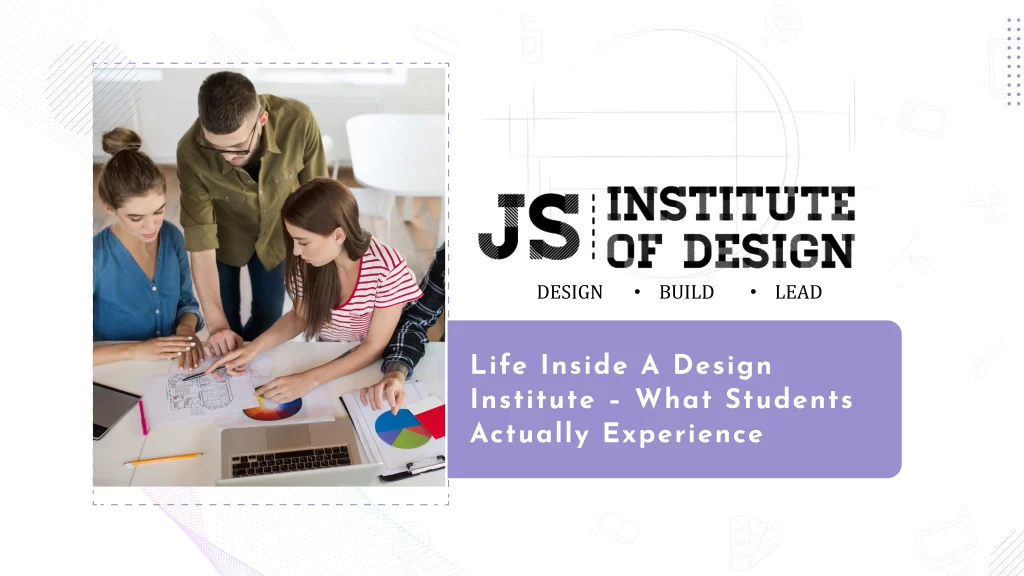
Education for designers differs greatly from regular schooling. For students studying at design schools, there is less time spent on theoretical learning and more emphasis on idea creation, problem-solving, construction, and development of creativity skills. Life in a design institute is highly practical and includes studio works, teamwork, workshops, presentation sessions, and ongoing projects.
Students often picture design schools as institutions where nothing more than drawing takes place. The reality is that there is far more to the process. Students learn by tackling genuine design problems, using professional-grade equipment, engaging with industry professionals, and creating excellent portfolios to prepare them for their future careers.
At JS Institute of Design (JSID), students get the opportunity to live life at a design institute through exclusive courses such as Interior Design & Styling, Communication Design, UI/UX & Digital Product Design, Animation & Motion Design, and Game Art & Design. From the website of JSID, it can be said that the JSID emphasizes on experiential learning, studio education, industrial projects, portfolio building, and international outlook through their academic association with École Intuit Lab, France.
JSID offers its students the opportunity to learn in an industrially-oriented setting where practical training holds equal weightage as theoretical knowledge. Students from Interior Design, UI/UX Design, Animation, Communication Design, and Game Art courses are actively engaged in various workshop sessions, live projects, studio learning, and portfolio-building activities.
At JS Institute of Design, there are 22+ years of excellence, 1000+ industry partners around the globe, 98% placement rate, and up to 50% scholarships available for eligible candidates. All these features make the overall life at a design institute more professional.
Academic Life in Design Institutes
The curriculum for academic education in design schools is highly oriented towards creativity, practice, and conceptualization. Instead of assessing the students only based on their performance in written tests, the institutions assess them by way of project work, presentation, assignment, and portfolio work.
Curriculum at JSID has been built on specialized creative programs that include Interior Design & Styling, Communication Design, UI/UX & Digital Product Design, Animation & Motion Design, and Game Art & Design. Students are trained in classrooms and studios where they are assigned real-world projects to build their portfolios through academic learning, internships, and workshop sessions.
Project‑based learning
One of the major aspects of design institute education is learning through projects. Students constantly undertake projects to challenge their creativity, technical ability, and problem solving. Projects can be based on:
- Interior space planning and styling projects
- UI/UX wireframing and interface design tasks
- Branding and visual communication assignments
- Motion graphics and animation projects
- Game environment and character design tasks
- Digital storytelling and content creation projects
- Exhibition and spatial design concepts
JSID specifically emphasizes project-based learning and mentoring by professionals, which means that the students will be able to take part in practical assignments that resemble real-life designs. Each project usually follows multiple stages:
| Project Stage | What Students Do |
| Research | Study user needs and trends |
| Ideation | Create concepts and rough ideas |
| Development | Improve designs using feedback |
| Prototyping | Build models or digital versions |
| Presentation | Explain final design concepts |
The projects undertaken by the students of JSID expose them to a life in a design institute. The projects will also enable the students to enhance their creative skills, software proficiency, presentation skills, and portfolios.
Continuous assessments
Unlike traditional universities which award most points based on end-of-the-term tests, design institutions conduct continual evaluation of their students. These can consist of:
- Studio participation
- Design submissions
- Presentations
- Portfolio reviews
- Jury evaluations
- Class assignments
This approach ensures that students remain focused for the entire duration of the semester. This method makes sure that the students are always engaged in their studies rather than cramming at the eleventh hour. Students generally find this approach challenging at first, but with time they learn to cope well. In JS Institute of Design, the emphasis is on the quality of portfolio, creativity, presentation, actual practice, and involvement in studio discussions instead of only written exams.
Portfolio assessments, mentoring by tutors, workshops, and creative discussions are essential parts of the academic procedure that contribute greatly to improving a student’s portfolio at JSID.
Studio‑Based Learning Environment
The studio culture is one of the most unique aspects of student life in design college. Studios are places where students work long hours in collaboration with their peers in discussions, model making, drawing, etc. The setting is very interactive and pragmatic.
Creative spaces
Design institutes usually provide multiple specialized creative spaces depending on different design disciplines. These may include:
- Art and sketching studios
- Computer labs
- Photography studios
- Fashion workshops
- Material testing labs
- Product design workshops
- Animation labs
- Digital media studios
At JSID, students have access to design studios, CAD laboratories, digital learning environment, workshops, computer laboratories, and resource centers, thus facilitating studio and experience-based learning in various fields of design.
In addition to classroom sessions, students have extra hours spent in the studio to finish work, get more practice on software usage, or perfect presentations. Learning in the studio also inspires students as they always come across new creative minds in the studio. Lastly, studio learning contributes significantly to developing design thinking.
Practical sessions
Practical learning is one of the strongest aspects of design institute learning. Students at JSID undergo training by using software and equipment that are relevant in the industries regarding UI/UX design, animation, visual communication, branding, interior visualization, and motion graphics according to their specialized fields. Design students devote plenty of time to practical classes where they implement theoretical concepts using their hands. Practical classes can involve:
- Model making
- Digital illustration
- Typography exercises
- Product prototyping
- Fabric experimentation
- Photography shoots
- Video editing
- Software training
Another focus of JSID is that of practical exposure through internships and workshops. Students get to work with leading companies and design firms through their internship programs and projects.
Such classes assist students in building technical knowledge as well as creative confidence. Practice-based learning helps students learn about the workflow and industry standards. Students will develop better portfolios through constant practice, and such portfolios will be very useful for internships and placements.
Daily Routine of Design Students
The typical day-to-day life of a student in a design institute is normally filled with activities such as learning, discussions, and projects among others. The typical day includes classes, practical work, doing research, making presentations, brainstorming, and completing assignments. This depends on various factors such as project deadlines.
Classes and lab work
The design students get involved in theoretical classroom lectures as well as hands-on laboratory sessions within their day-to-day activities. Design college experience is more practical in nature, and therefore, the students get to spend most of their time in studios and laboratories carrying out various designing tasks.
JSID students have the benefit of studying under experienced faculty members, creative minds, and professional mentors from various fields including branding, architecture, animation, UI/UX, visual communication, and digital media. The institution even offers its students an international exposure through its academic partnership with École Intuit Lab.
Some of the typical subjects covered in design classes include basic designing principles, color, visual communication, materials, design history, and design software. These subjects enable the students to develop a proper understanding of creativity, layout, colors, visuals, and the entire designing process.
| Subject | Main Focus |
| Design Fundamentals | Basic principles of design |
| Color Theory | Understanding color combinations |
| Visual Communication | Presenting ideas visually |
| Design Software | Digital designing skills |
| Material Studies | Learning material properties |
| Design History | Understanding design evolution |
Academic life is unique based on the specialization that each individual chooses in JSID. While Interior Design & Styling learners concentrate on spatial planning and material application, Communication Design learners study branding, typography, and visual communication. Meanwhile, the curriculum of UI/UX & Digital Product Design is focused on user research and interface design while the Animation & Motion Design specialization is all about storytelling and motion graphics.
Laboratory classes and studio learning form an essential aspect of a student life in design college. Sketches, designing, prototypes, and other computer-related tasks are performed by students in their lab classes, making students proficient in terms of creativity and problem-solving skills. JSID students also get to learn from a global perspective through international workshops and exchange programs linked to École Intuit Lab.
Furthermore, students are taught how to use standard software, such as Adobe Photoshop, Illustrator, Figma, AutoCAD, Blender, and After Effects. Learning software is an essential component of a design institute learning as it allows students to make professional designs and portfolios in their future career.
Assignments and projects
Assignments are common in student life in design college. They often have several assignments that demand creativity, research, and presentation skills. The assignments might be:
- Mood boards
- Research reports
- Digital posters
- Design concepts
- 3D models
- User analysis
- Presentation slides
JSID students have the opportunity to engage in live creative projects, portfolio building activities, and multi-disciplinary projects in preparation for internships and placements. Project learning has great importance in creating the overall life in a design institute since the students always manage between presentations, deadlines, collaboration, studio activities, and creativity.
Peer Interaction and Collaboration
Collaboration is highly significant in the overall process of design college education. In contrast to conventional classroom-based programs that focus on individual efforts, student life at design colleges consists of constant interaction among peers, faculty, and team members. The bulk of college life for design students comprises brainstorming, analyzing theories, undergoing critiques, and tackling design-related problems.
Students in most design schools are unlikely to engage in solitary activities throughout their period in academia. Collaboration is a regular feature of student life whether in studio classes, workshop sessions, portfolio preparation classes, or practical classes.
It is common practice within a design school culture to share one’s views freely. Design quality improves in peer discussions as students receive alternative perspectives, design inputs, and feedback from peers.
Group projects
Group projects form a significant aspect of design institute learning. Design colleges usually have collaborative projects for their students to enhance their skills in communication, coordination, and collaboration. Collaborative projects emulate real industry working conditions where designers usually operate as groups rather than individuals. Some group project assignments include:
- Branding campaigns
- Product development
- Exhibition planning
- Fashion styling concepts
- Installation design
- Advertising presentations
- User research projects
- Packaging design tasks
Multidisciplinary cooperation is encouraged in JSID; for example, Interior Design, Communication Design, UI/UX, Animation, and Game Art students typically collaborate during various workshops, studios, presentations, and other assignments. Teamwork amongst students is common practice in workshop classes, studio classes, presentations, and projects.
| Benefits of Group Projects | How Students Benefit |
| Team Coordination | Learn how to divide responsibilities |
| Idea Sharing | Generate more creative concepts |
| Communication Skills | Improve presentation and discussion abilities |
| Problem Solving | Handle project-related challenges together |
| Leadership Skills | Learn project management and coordination |
Collaborating in groups further enhances the skills of the learners in resolving conflicts and handling constructive criticism in professional terms. Each individual will have diverse creative views, hence through teamwork they learn how to merge various views into a common solution. Learners also develop in terms of:
- Leadership skills
- Coordination abilities
- Creative thinking
- Presentation confidence
- Time management
- Decision-making abilities
This is very important since the design sector relies very much on teamwork among the designer, client, developer, marketer, and many other creative individuals. It has been said that for most students, doing projects in a team is one of the most unforgettable experiences of life in a design institute.
Creative teamwork
Creative teamwork is one of the strongest aspects of student life in design college. Design students routinely collaborate on creative solutions to problems to enhance their projects’ success.
Unlike conventional learning programs, which concentrate heavily on examinations, design education emphasizes dialogue and information exchange among students. They tend to engage themselves in group discussions, seated in classrooms, talking about their designs, typography, coloring, and other related aspects for long periods. Peer feedback is vital to enhancing the quality of projects. This is achieved through:
- Refining concepts
- Improving layouts
- Suggesting better color combinations
- Generating fresh ideas
- Learning new techniques
- Correcting presentation mistakes
- Understanding audience perspectives
Such a form of cooperation enhances the creativity of the students since they get exposed to varying styles of designs. Collaboration becomes easier through the studio structure, where students engage in activities together while working on projects within the same place. The discussions carried out in studios become an important learning process. The studio culture at JSID fosters a never-ending process of collaboration, ideation, criticism, and idea exchange, which makes life in a design school a very interactive and creative experience.
Exposure to Industry Trends
Design training today emphasizes industrial exposure since there are constant changes within the creative industry in terms of technologies and tools used in addition to changing design trends. It is a norm for design schools to make sure that their students are up-to-date with contemporary industrial trends. Industrial exposure will enable learners to relate concepts to reality.
JS Institute of Design has placed great importance on providing industry exposure to the students by means of internships, workshops and live projects.
Workshops
Design Workshops form one of the most essential elements of life in a design institute. Through workshops, students gain practical experience, learning firsthand from professionals and experienced artists or designers. In contrast to regular classroom instruction, workshops are very interactive. Some of the types of workshops are:
| Workshop Type | Skills Developed |
| Typography Workshops | Font design and visual layouts |
| UI/UX Workshops | User interface and user experience design |
| Photography Workshops | Camera techniques and editing |
| Branding Workshops | Marketing and identity design |
| Illustration Workshops | Drawing and storytelling skills |
| Animation Workshops | Motion graphics and visual animation |
These workshops allow students to gain knowledge of how design concepts are applied in real-world situations rather than just through textbooks and theoretical courses. In addition to this, students also gain knowledge of:
- Industry-level software usage
- Current design trends
- Presentation techniques
- Creative experimentation
- Material handling methods
- Professional workflows
At JSID, the students participate in international workshops and industry lectures for branding, UI/UX, animation, visual communication, interior styling, and digital storytelling, which are delivered by experienced individuals.
Guest lectures
Guest lectures can also be considered as a very important aspect of design college experience. There are regular guest lectures at the design institutes where they invite entrepreneurs, creative directors, artists, photographers, professionals, and even designers to interact with students. These guest lectures offer the students first-hand experience of the designing industry.
- Industry expectations
- Portfolio preparation
- Career opportunities
- Freelancing and client work
- Design trends
- Startup culture
- Creative career growth
- Professional communication
Learning from personal stories of individuals working in the field allows the students to gain insight into the pros and cons of their chosen career path. A lot of guest lecturers also provide tips on:
- Internship preparation
- Resume building
- Networking
- Personal branding
- Handling deadlines
- Managing clients professionally
These classes encourage the students and make them career-oriented. Interaction with industry professionals also enables the students to comprehend how professional designers strike a balance between their creativity and market demands. For many students, lectures by industry professionals prove very motivating as they serve as real-life instances of successful creative professions.
In JSID, guest lecturers and mentor sessions are provided for students to understand the expectations of the industry, portfolio preparation, freelance work, and how to build their careers creatively.
Conclusion- Understanding Real Student Life in Design Institutes
The real life in a design institute is a blend of innovation, learning, collaboration, exploration, and growth. It involves the students’ entire educational process spent designing, working through various workshops, undertaking studio learning, and creating portfolios that help pave the way to their careers.
Programs offered by JS Institute of Design include Interior Design and Styling, Communication Design, UI/UX and Digital Product Design, Animation and Motion Design, and Game Art and Design. Being an institute where students are exposed to hands-on learning experience, international exposure, workshops, internships, live projects, and portfolio building, JSID provides students with a very practical and industry-specific life in a design institute.
While studying design is not always easy due to numerous tasks and tight schedules, it is beneficial in developing important qualities like creativity, self-confidence, good communication, teamwork, and critical thinking. For those who have an interest in innovation, visual communication, and practical studies, student life in design college will be very rewarding and career-oriented.
FAQs
1. What is life like in a design college?
At JSID, life in a design institute entails creativity, interaction, and projects. The students at JSID are involved in studio education, workshops, demonstrations, real-life projects, and portfolio building activities.
2. Are there more practical classes?
It is evident that JSID stresses a lot on practical education. Practical projects, software classes, workshops, creation of portfolios, and much more constitutes student life at a design institution.
3. Do students work on real projects?
JSID students get involved in industry-related projects on UI/UX, branding, animation, interior design, and visual communications, thus gaining experience for their portfolios.
4. How important is teamwork?
Team work plays a vital role in the lives of students enrolled at JSID Design Institute. Collaboration between students takes place through studio classes, project work, and presentations.
5. Are assignments frequent?
There are always numerous assignments, presentations, design concepts, and portfolio projects that JSID students undertake to hone both their practical and creative skills.
6. Do colleges offer workshops?
Yes, JSID always organizes workshops, guest lecturers, and industry sessions where the students get to know the latest design trends, software packages, and methods of designing.
7. Is the design study stressful?
Design studies at JSID may prove to be challenging because of the project deadlines as well as the constant assignments. However, the same also helps students develop qualities such as creativity, self-discipline, confidence, and professionalism.